Claim Analysis Blog Post: The “7-38-55 Rule” in Communication
Claim being analyzed: The popular claim that only 7% of communication comes from words, 38% from tone of voice, and 55% from body language
Why was this assertion worth following up on:
This assertion appealed to me since it appears everywhere in communication posts, methods of speaking in public, and graphics on social media platforms, yet it also sounded too on point to be something that is universally applicable. The claim, in percentages such as 7%, 38%, and 55%, sounds scientific, but the manner in which it is repeated on the internet tends to omit the context. That is a red flag. When a statement is given out as a simple formula to a thing as complex as human communication, it is worth taking the time to reexamine what the original study actually stated (UTBP, n.d.).
Step 1: Find out the claim on record
The first thing that I did was to paraphrase the claim. The online version typically indicates that “55% through body language, 38% through tone of voice, and only 7% through spoken words.” There are some versions which state that body language is more crucial than words in all situations. The choice of words is crucial, since an argument may sound plausible in one situation, but become misguided when it is generalized (UTBP, n.d.).
Step 2: Do lateral reading and look for the original source
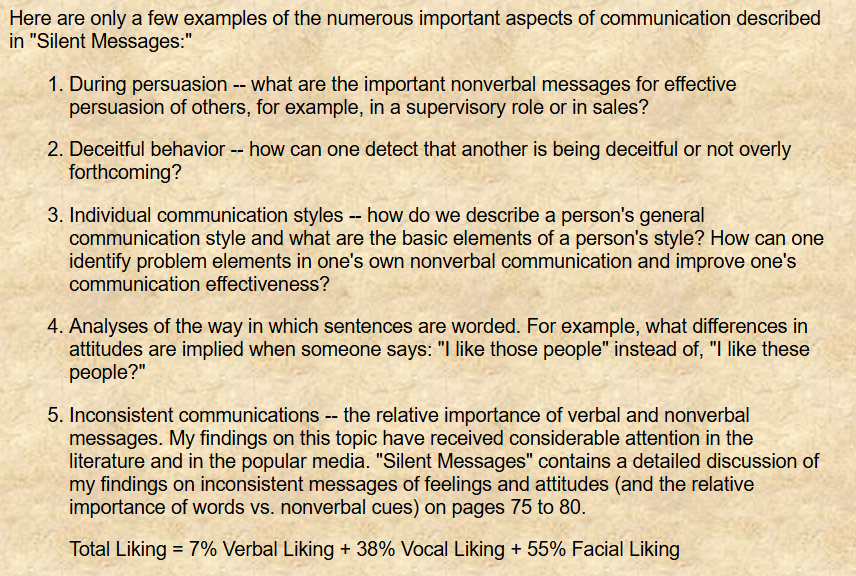
I did not trust the post but rather sought to find out the first person to make the numbers. That prompted me to his own explanation by Albert Mehrabian on his own site. When describing silent messages, Mehrabian states that the well-known equation, “7% Verbal Liking + 38% Vocal Liking + 55% Facial Liking”, was the result of experiments concerning feelings and attitudes, particularly like-dislike situations. He further explains that the equation cannot be applied unless a communicator is discussing feelings or attitudes. That is a significant correction, as it demonstrates that the popular version is not wholly developed and tends to be abused (Mehrabian, 2016).
Step 3: Cross-reference the claim with a second source.
I then consulted a source that gave the description in simple terms. According to the advocacy blog at Temple University, the 7% assertion is a myth and elaborates that Mehrabian was just assessing a narrow point: how word choice and delivery perform when a person is attempting to express emotion. The article makes it clear that the study did not imply that words are necessarily only 7% of communication. That assisted me in confirming that the viral variant overgeneralizes the study (Epstein, 2021).
Step 4: Check whether the claim still has a kernel of truth
The question was not in the form of a statement: Is the claim entirely false? But: What is the part of the statement that is true? The communication article by UT Permian Basin describes that the 55/38/7 formula is associated with a particular task: a comparison of facial and vocal expressions to read the attitudes. The article further indicates that the 90% number is not accurate, but nonverbal messages have a significant impact on how individuals decode messages. That assisted me in decoupling the original study and the over-the-top internet slogan (UTBP, n.d.).
My takeaway from all this: the original viral claim is misleading-but-still-based-on-real-research, when presented in a form that differs from the actual findings of the original research. The original study did find that asking some follow-up feeling/attitude questions greatly decreased the likelihood of accurate responses, but only in very specific circumstances (i.e. when the questions are about inconsistent feelings/attitudes and are asked right after the main survey) This means that the core of the viral claim is based in reality, but it's been retooled and misrepresented for internet consumption. Which is why verification is so important: a neat, polished-up statistic can sound accurate when it's not, and spread just as far as honest, careful research.
For anyone from media and communication studies to almost any other discipline, this process is very relevant as we all consume claims online. The most believable forms of misinformation originate from real sources that have been simplified to the point of inaccuracy. By identifying the claim, tracking back the claim to its original source and context, checking against other credible sources, and paying attention to whether the language of the sources matches the evidence, we can avoid disseminating what turns out to be false information.